Posts

Roman Catholic Via Ferrata

Image
Austrian Universities take their holidays seriously and the two-week mid-semester Easter Break begins this week at the University of Innsbruck.  This is the best opportunity we have to do a bit of traveling beyond the Tirol and we are currently in Florence, Italy attempting to get cultured.  One of the major attractions is the Cathedral of Santa Maria del Fiora, known more widely as the "Duomo."  Pretty incredible place inside and out.  One can climb up through the Duomo, which is a sort of Roman Catholic Via Ferrata.  No harness needed, but the 500 stairs and narrow passageways add to the medieval feel. My idea of culture is weissbier and gröstl at a gasthaus in the Tirol, but I have to admit that Michelangelo's David is absolutely incredible to see in person.  Florence is also well known for food and yesterday Andrea and I tested the hypothesis that you can't eat too much gelato or drink too much wine.  We stumbled across the ...
Weather Perspectives of Skiing in Western Austria

Image
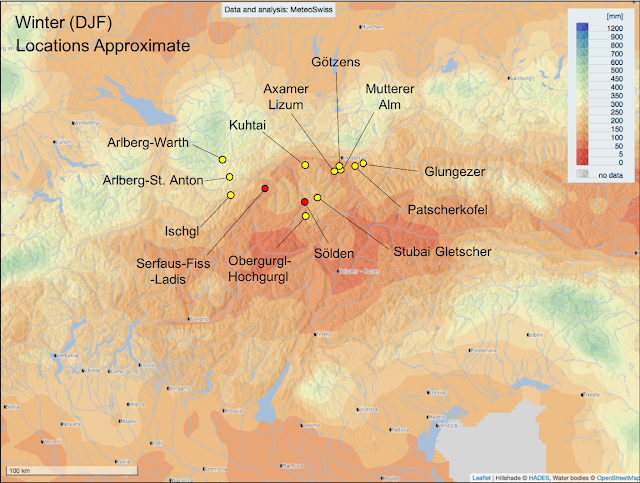
We've reached the half way point of my sabbatical in Austria and it seems like a good time to provide some weather perspectives on skiing in this part of the world. Andrea and I have skied at a number of ski areas in western Austria including Ski Arlberg, Ischgl, Obergurgl/Hochgurgl, Stubai Gletscher, Kuhtai, Axamer Lizum, Patcherkofel, Glunguzer, Mutterer Alm, Götzens, and Schlick2000.  I've indicated these and two other large resorts, Sölden and Serfaus-Fiss-Ladis, on the images below, which illustrate the mean precipitation (water equivalent) during winter (December to February) and spring (March to May). The greatest precipitation in western Austria and the neighboring region falls on the Alpine "rim", the initial mountains and foothills in the northern and southern Alps.  The interior Tirol of western Austria is a comparatively dry place, receiving less precipitation.  This is true in winter and spring, with the latter producing more precipitation across the ...

The Disappearing Glaciers of the European Alps

Image
I am spending the first part of this week at the European Geophysical Union (EGU) meeting in Vienna.  One of the things that I like about meetings of this type is the opportunity to learn about advances in Earth sciences disciplines outside of the atmospheric sciences. Glaciology talks has always been a personal favorite because of my love for snow and ice and the fact that they contain many beautiful photos and analyses.  The science of glaciology has been transformed in recent years by advances in numerical modeling, observational techniques, and remote sensing from space, aircraft or the ground.  Sadly, these advances, while providing greater detail and information than ever before, confirm the dramatic loss of glacial ice that is occurring around the world. My host institution here in Austria, the University of Innsbruck, is a world leader in glaciology.  Glaciers that they study extensively include the Hintereisferner (HEF), Kesselwandferner (KWF) and G...

Stubai Glacier Revisited

Image
Today was our last chance to ski our favorite local Innsbruck ski area, Axamer Lizum, but it was their "Ugly Ski Day", which we understand is a bit like Alta's Frank on steroids.  We were warned it would be a long day of debauchery and an even longer and exceptionally cramped ride on the bus, so we elected to go with a friend to Stubai Glacier instead. Stubai is near the Alpine divide and benefited from the southerly flow storm on Thursday, picking up 80 cm of new snow.  It was closed on Friday due to avalanche danger.  Thus, the resort was essentially untracked when we arrived. Avalanche danger was considerable, but everything was skied with impunity by the volunteer stability testers.   The most serious incident we saw was someone rag dolling down a steep face while we were on our first chairlift ride.  They survived, but one of their skis did not elect to surface.  He looked for about 2 hours, but said ski was never found.  He probably wa...

Bye Bye Patscherkofel

Image
As far as ski areas go, the Patscherkofel south of Innsbruck was not blessed with great meteorology.  I often think sarcastically that it doesn't snow very much there, but at least the wind blows hard.  It is surrounded by higher terrain, so it doesn't get a lot of snow, and it is highly exposed to strong southerly "Foehn" winds that issue from the Brenner Pass and down the Wipp Valley. It does, however, have a couple of things going for it.  It is close to Innsbruck and it sits at the end of a bus line with a stop near our apartment, with no charge if you are carrying skis during the ski season. As a result, I have ski toured the Patscherkofel nearly once a week since we arrived.  It is very popular with tourers like myself looking for a quick workout, and you can have a treat at one of the mountain huts near the summit.  Below are a couple of photos from late January when the area was a winter wonderland. Today was less appealing, but my last chanc...

Southern Alps Getting Some

Image
The northern Alps have been the primary beneficiaries of snowfall this season, but not to be ignored, the southern Alps saw or are seeing action from yesterday through today.  The image below shows the snowfall forecast for the Alpine region as produced by ZAMG, the Austrian Weather Service, and provided by bergfex.com.  Amounts in excess of 50 cm are expected in high altitude regions of the Eastern Valais, Bernese Oberland, and Graubünden Cantons of Swizerland and in high mountain areas of northeast Italy.  A complex upper-level trough and frontal system moving through the area is the synoptic driver of this snowfall.  Moisture transport through the gap between the Rhone Alps and Apennines and by blocked flow up the Po Valley, combined with the convergence and orographic lift of those two airstreams, is contributing to precipitation generation in the East Valais and Graubünden.  Heavy rain will also fall in lower elevation areas of Switzerland and Italy....

Exploring above Innsbruck

Image
One of the great things about living in Salt Lake City is easy access to hiking and mountain biking trails. The same can be said of Innsbruck, although a strong argument can be made that the situation here is even better. We are staying in Hötting, an area of town just north of the Innsbruck's old down and just left of center near the bottom of the valley below.  Much of the area north of the Inn River shares similarities with Salt Lake's Avenues neighborhood in that the slopes are south facing and there is an extensive trail network in the mountains above it. However, there are some major differences.  First, the lower slopes are tree covered.  Second, the relief extends up about 1750 vertical meters. Finally, there are restaurants and guest houses to find and stumble home from. Now that the days are longer and the snow line is retreating up the mountains, we've begun explore the area.  Our most direct route up the hill follows the "Höttinger Höll" cli...