Showing posts with label Politics. Show all posts

Friday, June 5, 2026

Temporary Halt of the Dismantling of NCAR

The National Center for Atmospheric Research Mesa Lab.  Source: Aaron Seltzer/Getty Images.

Earlier this year, the Trump administration moved to dismantle the National Center for Atmospheric Research (NCAR). One component of that dismantling was temporarily halted earlier this week by a Federal judge in Colorado.    

NCAR is run by the University Corporation for Atmospheric Research (UCAR), which was founded in 1959 and is a non-profit consortium involving more than 100 institutions of higher education.  In February, the National Science Foundation (under the direction of the Trump Administration) informed UCAR that it would transfer management and operations of the NCAR-Wyoming Supercomputer Center (NWSC) to a third-party operator.  UCAR's lawsuit argued this was a violation of federal law.  The temporary halt was imposed by after the Federal judge in Colorado decided that the transfer was arbitrary and capricious. More information is available at https://eos.org/research-and-developments/judge-blocks-nsf-from-dismantling

This is, however, a temporary reprieve and efforts to dismantle NCAR by the Trump administration will continue.  Real damage is being done to atmospheric science (and American science in general) by these and other actions by the Trump administration. 

NCAR is undoubtably the leading center for atmospheric research in the world.  Other major centers, like the European Center for Medium Range Weather Forecasting (ECMWF), Met Office Hadley Center, or Max Plank Institute for Meteorology have more focused missions and lack the breadth of NCAR.  NCAR also has strong ties to universities and provides important collaboration, education, and training opportunities for University faculty and students.  

NCAR has been an important thread through my entire career.  As a graduate student, I began to work with an atmospheric modeling system that was jointly developed by NCAR and Penn State University.  This modeling system, known as MM4, eventually became the MM5, which was ultimately replaced by what we know today as the Weather Research and Forecasting model (WRF).  In the early 1990s, there were only a handful of MM4 users, but by 2021 there were almost 60,000 registered users of WRF.  It is used for operational forecasting (e.g., the HRRR is based on WRF), simulations of historical events to enable diagnostic calculations or sensitivity studies not possible with observations alone, and regional climate simulations.  Many private sector companies use WRF.  

I have also been involved in field campaigns that have used NCAR's observing systems and field program support services.  The observing systems include heavily heavily instrumented Gulfstream G-V and C-130 aircraft, a polarimetric radar facility, and a variety of surface-based atmospheric sounding and profiling systems.  NCAR is vitally important for field campaign management, which can be highly complex involving in some cases hundreds of scientists and students spanning institutions not just in the United States but often in many countries (and field campaigns are often international in nature and NCAR serves a critical role here as well).  

I don't know how we got to a place where we are talking about dismantling a critical facility for the future of the Nation and humanity, but here we are.  Given the impacts of weather-related disasters in the US, we should be investing in NCAR rather than tearing it down.  Building weather and climate resiliency requires advanced knowledge and cutting-edge modeling tools.  NCAR is a wise investment for a country that experiences the greatest diversity of high-impact weather in the world and a planet that is in the early stages of abrupt and rapid climate change.  

Wednesday, December 17, 2025

Save NCAR

I'm currently in Alaska and was planning on ignoring the blog for a few days, but I felt the need to address the news released yesterday that the National Center for Atmospheric Research (NCAR) would be dismantled.   

At this point we know little except that NCAR is under threat based on a social media post by the Office of Management and Budget director Russel Voight stating that the National Science Foundation will be breaking up NCAR, reviewing its activities and "vital activities such as weather research will be moved to another entity or location." 

Subsequently, the National Science Foundation (NSF) announced today the intent to restructure NCAR's activities including "options to transfer stewardship of the NCAR-Wyoming Supercomputer to an appropriate operator; divest of or transfer the two NSF aircraft that NCAR manages and operates; and redefine the scope of modeling and forecasting research and operations to concentrate on needs such as seasonal weather prediction, severe storms, and space weather."

In that announcement, the NSF stated that they remain "committed to providing world-class infrastructure for weather modeling, space weather research and forecasting, and other critical functions."  It's pretty clear that is not the case and that they are embarking on a process that will destroy NCAR.  

Since it's inception in 1960, NCAR has been the undisputed #1 center for atmospheric research in the world.  No other center comes close.  It has built the world's most widely used modeling system, the Weather Research and Forecasting model; operates some of the world's most sophisticated observing systems including the NCAR NCAR Gulfstream GV for high-altitude sampling and C-130; and employs many of the most brilliant scientists in the atmospheric sciences.  It also developed the Community Earth System Model (CESM) and the Model for Prediction Acros Scales (MPAS) model, which is likely to be come the backbone for weather modeling in the National Weather Service (and is currently being used by The Weather Company for their forecasting activities).  

Don't be fooled by suggestions that vital activities will be moved to other entities or locations.  Even if that happens, US capabilities in the atmospheric sciences are going to suffer severely.  NCAR has a critical mass of scientists to tackle some of my fields most challenging problems.  Breaking up NCAR is like breaking up the 1927 Yankees.  You can ship off Lou Gehrig, Babe Ruth, and the rest of Murderers' Row to other teams, but in the end you're left with mediocrity, not greatness.  Thankfully, the 1927 Yankees did not break up and they won the 1928 World Series in four games.  Let's hope that NCAR similarly is kept together. 

Wednesday, October 15, 2025

The Importance of Research for Teaching

Higher education is currently under siege and facing many challenges including declining public confidence and trust, funding cuts, and political interference.  Amongst the many questions being raised concerns whether university professors need to teach more, with greater prioritization of teaching over research.  When addressing this question, the public, politicians, and even professors and provosts often assume that research and teaching are mutually exclusive activities.  This stovepiped view of research and teaching has some conveniences, but the reality is that the best professors create a strong synergy between research and teaching to the benefit of students.  

During my 30 years at the University of Utah, I have served as the lead or co-principal investigator on more than 30 external research grants, but have also won college and university teaching awards.  I am classified by my department as a "research intensive" faculty member, but I also care deeply about teaching.  I know many other faculty who are similarly committed to both research and teaching, and recognize that there are many benefits of research for teaching (and vice versa).  

In many ways research is teaching because a good deal of external research funding supports graduate and undergraduate students.  Well over half of my grant support (maybe more than 75% in some cases) goes to graduate and undergraduate students and, as a result, much of the time I spend on research is actually spent mentoring graduate and undergraduate students.  This includes guiding them through their research and helping them become scientists who can innovate, create new knowledge and techniques, work in a team, and be effective if not outstanding communicators.  

In other words, teaching.  

Research also enables the latest advances to be brought into the classroom.  Readers of this blog are well aware of the products on weather.utah.edu.  Although we get no direct funding for the web site, we have developed it to provide access to the latest forecast techniques and enable their use in the classroom.  For example, students can use the Utah Snow Ensemble, which uses downscaling and machine learning techniques to produce a large snowfall ensemble.  This product is not only being used in upper-division atmospheric sciences classes, but even introductory ones such as Atmos 1000: Secrets of the Greatest Snow on Earth.

Research funding also provides experiences for students who may not be a formal member of my research group, including those in physical labs or in the field.  I nearly always build in a research experience opportunity for students into my National Science Foundation grants.  For example, we have brought the Doppler on Wheels (DOW) radar to Utah on two occasions to teach students about radar meteorology and mountain precipitation.  

Fun times in the Doppler on Wheels

For this winter we are planning a large field campaign focused on the northern Wasatch.  We currently have undergraduate and graduate students helping to configure and deploy observing systems for that campaign.  During field operations, students will launch weather balloons and operate DOW radars.  All of this because of research.  

Finally, teaching also benefits research.  Having to teach classes requires a much deeper understanding of fundamental subject matter, which makes you a better scientist, but it also exposes gaps in understanding.  Classroom discussions have helped me to identify or refine research questions and ideas on many occasions.  

This synergy between research and teaching, and the benefits of research for teaching, seems to be missing in the public dialog about the future of higher education.  In fact, I would say it is even inadequately considered on college campuses.  Most policies for evaluating faculty productivity or workload, for example, very clearly distinguish between research and teaching, which are often treated in near isolation for faculty reviews.  

It is for the reasons above that I am opposed to sledgehammer proposals to simply increase faculty teaching assignments.  In some disciplines or for some faculty members this might make sense, but in other situations, it could harm the mutually beneficial balance of research and teaching that benefits students.  It would certainly harm the quality of instruction in scientifically intensive disciplines that are evolving rapidly.  

Wednesday, July 23, 2025

Impacts of Trump Cuts at the U

A recent article in the Deseret News highlighted that the University of Utah could be in danger of losing $100+ million annually due to the Trump Administration's grant policies.  

In reality, as discussed to some degree in the article, the policies and budget being pursued by the Trump Administration are far worse than that.  

Although it's a bit ambiguous what the Deseret News editor's based the $100 million figure on, it appears it is the proposed reduction of indirect cost rates applied to grants from current levels (which vary by institution but are typically in the 45–60% range with some lower and higher rates) to 15%.  At the University of Utah, the current rate is 54%, which is applied to most grant expenditures except for a few things such as permanent equipment over $5000, tuition, and participant support. Indirect cost rates are negotiated between institutions and federal agencies and are meant to cover administrative overhead, facilities costs, etc.  For example, I need access to staff to administer my grants and building space for staff and students.  Those costs are not explicitly included in my grants, but are part of the indirect costs. 

The Trump Administration has proposed to cut indirect costs to a rate for all institutions of 15%.  Although many faculty (including me) grumble about the size or growth of indirect costs, the reality is that they are a necessary component of any grant.  A 15% rate is far too low and would not recoup many of the implicit costs of doing research at most institutions.  

As discussed in the article, an alternative is being proposed, which is called the FAIR model and provides more explicit accounting of the indirect costs.  One of the lead developers of this effort is Kelvin Droegemeier, who is not only former White House Office of Science and Technology policy director, but also a Professor of Atmospheric Sciences at the University of Illinois.  It's unclear if this will gain traction.

In addition, the $100 million loss emphasized in the headline actually sugarcoats what the Trump Administration is purusing.  The President's budget cuts the National Science Foundation by 55% and the National Institutes of Health 40%.  It also cuts NASA, NOAA, DOE, and EPA.  It is a vicious attack of science pursued or funded by government agencies.  

Thus, the decline in indirect costs, is just the tip of the iceberg.  Under the President's budget, the U's federal funding would decline precipitously, perhaps by about 50%.  

But it gets worse than that.  Federal funding supports graduate students and graduate student tuition.  Without that support, some will not continue in graduate school.  This will result in a decline in student credit hours and tuition.  These are indirect effects that will have very real impacts students and the University of Utah, as well as the development of a STEM workforce.  

In theory, congress ultimately passes the budget, although it has failed to do this in full for a very, very long time, relying instead on a patchwork of bills and continuing resolutions.  The last I saw, cuts in appropriations committees in the Senate and House for the NSF, for example, were $16M and $2B, respectively, which are smaller than proposed by the Trump Administration, but in the case of the House, are still massive. 

Ultimately, the U and its students have a lot to lose, but really we all do given the return on investments in science for advances in medicine, health, technology, and economic development.  

Wednesday, July 9, 2025

Thinking Slow Instead of Posting Fast

A tip of the hat for the paraphrasing of post's title to Daniel Kahneman's excellent book, "Thinking Fast and Slow." 

Early in the morning on July 4, a flash flood hit the Guadalupe River in Kern County, Texas.  As I write this in the evening on July 9, media reports suggest there are 120 confirmed deaths and still more than 150 people missing.  

This is a terrible tragedy that given modern weather monitoring and forecasting capabilities shouldn't happen.  The question is why did it happen?

In our modern, social-media-driven, hyper-politicalized times, you can find just about anything to support your preconceived notions as to why this happened.  There have been reports blaming climate change, National Weather Service personnel cuts, National Weather Service forecasts, the retirement of a National Weather Service Warning Coordination meteorologist due to the actions of Doge, lax county emergency management officials, unapproved alarm systems, etc.  

This is a situation though that needs slower thinking and less fast posting.

What is needed is a careful, apolitical assessment of everything from the long-term education and preparation of communities to the issuing, content, and delivery of weather watches and warnings.  

This is a tragedy that shouldn't have happened.  For it to never happen again, we need to rise to the occasions, ask hard questions, understand where our scientific, political, and communications systems failed, and move forward.  This will take leadership and expertise, not social media posts, sloppy news coverage, or CYA politics.  

Saturday, June 28, 2025

Cuts to NOAA, NASA, NSF, Etc.

The budget cuts currently being considered by the US congress would have devastating impacts on American science and STEM workforce development, including the atmospheric and related sciences.  They are not surgical.  They will seriously impede American science and the education of students in science and engineering.  

I have reproduced below an e-mail that I received yesterday from the leadership of the American Meteorological Society summarizing these cuts and their related impacts.  Links are provided if you are interested in contacting your Senator.  

--------------------------------------------------------------

Thank you to everyone who has taken action by reaching out to members of Congress and sharing your perspectives on the critical importance of the weather, water, and climate enterprise to our nation and the federal government's foundational role. The weather enterprise keeps all citizens prepared for hazardous extreme events and helps to grow our economy, providing a great return on investment. 


The budget discussions in Congress continue, with many items yet to be decided. Please join us in continuing to share your concerns with decision makers! 


We have great stories to tell about the value of our enterprise and the transformational work being done in government laboratories, private sector companies, and universities. In mid-May, AMS Presidents (Stensrud, Sealls, Bamzai, and Colman) visited Congress, and more visits are planned for this summer. Many past AMS presidents and AMS members also have met with their elected officials, so know that you are not alone in your outreach efforts (AGU, AAAS, AIP, and Sigma Xi, and many other science societies are also encouraging member outreach). Indeed, collectively, we are doing our best to change the current budget trajectory. 


If there ever were a time to stand for science — and meteorological and related sciences in particular — this is it. Thank you for being an Upstander for Science!

It is challenging to keep abreast of deliberations on the Hill and all the moving parts, so below are reminders on current proposed budget items related to the weather, water, and climate enterprise and science in general. The House passed its version of the FY2026 budget in May, and the Senate is currently writing its version. The Senate is using a process called "Reconciliation" to pass their version of the FY2026 budget, which only requires a simple majority to pass. If the House approves the Senate's Reconciliation bill and President Trump signs it, it will become the law. At that point, the appropriations process would proceed to determine the annual funding levels for the agencies using the budget numbers specified through the Reconciliation process. Current proposals (see also the AIP Budget Tracker) include a:

  • 28% cut to NOAA, prioritizing funding for NWS while dissolving NOAA Research that includes funding for NOAA laboratories, cooperative institutes, and extramural projects to academia. This would dramatically slow down forecast model development, reduce observations and monitoring, and lead to the termination of NOAA-University partnerships. All in all, this bodes an uncertain future for weather radar and satellites, as well as a decline in weather forecast accuracy, with downstream impacts on costs related to energy, transportation, and agriculture. 
  • 47% reduction in NASA science and terminating support for the Orbiting Carbon Observatories, and the Terra, Aqua, and Aura satellites. Terra, Aqua, and Aura have been operating for decades and their observations are assimilated into forecast models as well as used to monitor droughts, dust, and air quality. The Atmosphere Observing System, and Surface Biology and Geology missions would also be terminated. 
  • 56% cut to NSF which supports university research (including graduate students) and NSF National Center for Atmospheric Research (NCAR). This would lead to greatly reduced university-led research, decline in graduate students that eventually constitute the next-generation of scientists in the field and a dramatic reduction in capabilities at NSF NCAR used by our community. 
  • 39% cut to USGS science, including the elimination of the ecosystem mission area, and a 14% cut for DOE Office of Science, both of which directly impact federal-university partnerships in earth and environmental sciences, as well as capabilities in national labs and atmospheric science research productivity.

To find your Congressional Representative or Senator you can use these resources:

Encourage your family and friends to reach out as well to amplify your collective impact!


If you have been affected by federal changes so far, you can find AMS resources here that may assist you.


Sincerely,


David Stensrud, AMS President 2025

Alan Sealls, Incoming President 2026

Anjuli Bamzai, Past President 2024

Brad Colman, Past President 2023

Thursday, May 29, 2025

Signs of the Times

These are minor issues compared to what many are dealing with, but yesterday I received two e-mails that are reflective of the times. 

In the first, I was notified that a proposal I submitted to a NOAA Weather Program Office competition was recommended for funding.  Normally this is good news, but this year, that news was accompanied with the caveat that they probably won't be able to find funding.  

That would be a shame because we were planning on using deep learning to further advance the the techniques approaches we've been developing to improve snow density and snow amount forecasting.  Many of the products on weather.utah.edu and features on this blog use experimental versions of these techniques.  Without support, this line of research will probably whither in the coming months as our current grant winds down (and this assumes that funding is not frozen). 

In the second, I was notified that I was eligible for the Voluntary Special Retirement Program at the University of Utah. You know you are getting old when you get one of these.   


The U has been tight lipped about their plans to address the HB 265 Strategic Reinvestment Plan.  They recently posted an online news article on @THEU that basically said little other than they presented a draft of phase one of the reinvestment plan to the Utah System of Higher Education (USHE).  Presumably this special retirement program is a small part of that.  

Based on that article, I suspect we will learn more in the near future, certainly no later than June 6 when plans are to be presented to the Utah Board of Education.  

Thursday, May 22, 2025

Declines in Awards from the National Science Foundation

Those of us who work at Universities and other scientific organizations are well aware of the cuts, layoffs, and damage affecting the American science enterprise under the Trump Administration.  An article published today in the New York Times describes what is happening specifically at the National Science Foundation (NSF), which for 75 years has supported research and education in science and engineering.  

In addition to the termination or freezing of grants related to diversity, equity, and inclusion (DEI), social justice, and misinformation/disinformation, funding awarded from January 1 to May 21st of this year by the NSF declined 50% from the 2015–2024 average. The declines were largest in the education directorate, followed by math, physics, and chemistry; engineering; and biology. 


Technically, these are declines in awards given.  The available funds could be doled out later in the fiscal year.  However, even if funds are eventually doled out, these delays cause declines in research assistantships for graduate students, layoffs, and disruptions in lab operations and research endeavors.  The delays are probably most problematic for new/young faculty members who represent the future of science and engineering in the United States.  

NSFs Division of Graduate Education in the Education Directorate has awarded no funding so far from January 1 to May 21.  None.  The average in prior years was $21 million.  As a result, the number of graduate research assistantships awarded by the program, which go to some of our Nation's the most promising young scientists and engineers, has declined this fiscal year (which begins in October) from 2,000 to 1,000.

These are not changes in the name of efficiency or an effort to simply excise funding related to DEI.  They are damaging the seed corn for future science and engineering in the United States, especially the development of young scientists who are supported not only by the Division of Graduate Education but also grants provided by other NSF directorates, which frequently are dominated by support for graduate students (and in many cases undergraduate students too).    

Friday, May 9, 2025

NSF Cuts Shutter NSF Unidata

There's an organization you may have never heard of, but if you are a user of weather data and graphics on the web, they have almost certainly contributed to the cyberinfrastructure that made it possible.

Their name is NSF Unidata, or just "Unidata" for short.  

Unidata developed organically in the 1980s when Universities has a pressing need to access weather data in real time, but couldn't.  The Internet at the time was nascent and there was essentially no hardware and software systems capable of delivering, processing, and analyzing weather data.  In 1983, a workshop at the University of Wisconsin involving about 80 US atmospheric sciences programs coined the name "unidata" and recommended that it be developed to provide:

  1. Access to current and archived weather data, including satellite imagery and forecasts.
  2. Support interactive computer capabilities at universities.
  3. Communications capabilities between universities, the National Center for Atmospheric Research, and NASA.
These are things that we take for granted today, but would not have happened without Unidata.  Amongst the products they developed are the Local Data Manager (LDM) which acquires and shares data between providers and users like the National Weather Service, NASA, and universities; netCDF (Network Common Data Form) which is a file format for storing self-described, multidimensional scientific data; and metpy which is a collection of python tools for reading and processing weather data.  They have been transformative for the atmospheric and related sciences, with benefits not only for universities, but also the private and academic sectors and across the world.  

I have benefited and been actively involved with Unidata throughout my career, including volunteer service on their Users and Strategic Advisory (formerly Policy) Committees.  Last year I gave a short virtual talk on Unidata's history that provides some examples of the various ways that Unidata has benefited my career and the atmospheric and related sciences as a whole (apologies that the initial part of the talk is cutoff in the video below).


On 30 April, the National Science Foundation (NSF) froze funding for Unidata, with instructions to stop all funded actions until further notice.  Due to this freeze, most staff in the Unidata program center are being furloughed effective today.  The impacts on are fully summarized below.  


This is yet another example of the damage being done to the US scientific enterprise by the Trump Administration.  Unidata is an example of an organization that has widespread support from the University community because it develops and provides essential scientific services for research and education in the atmospheric and related sciences.  The radar feeds that you take for granted today on your smart phone were first developed by the Unidata CRAFT product.  The distribution of model forecasts that you can access today was first developed by the Unidata CONDUIT project.  And a lot of the graphics that you see on the web rely on Unidata MetPy and visualization software.

These disruptions of the scientific enterprise are pure insanity.  The halting of funding to Unidata will stymie scientific advancement, slow educational innovation, and limit classroom experiences.  

Saturday, April 19, 2025

More Proposed NOAA Budget Cuts

The Trump Administration 2026 budget passback plan would be catastrophically bad for weather prediction in the United States.  

Below is a transcript of the letter that I sent to Utah Senator John Curtis and Representative Blake Moore concerning these potential cuts.  If you agree (or even if you disagree and want to share an alternative opinion), please consider writing your legislative leaders.   

--------------------------------------------------------------------------------------------

I am a Professor of Atmospheric Sciences at the University of Utah who has worked for 30 years to improve weather prediction in Utah.  I lead research to improve the understanding and prediction of winter storms in Utah’s mountains and develop methods to improve snowfall forecasting across the continental United States using artificial intelligence. The forecast techniques my group has developed are used by the National Weather Service and private companies.  I am also proud to have served as the graduate advisor for several Air Force officers who are contributing to weather support for our Nation’s defense.  I write today as a private citizen.  The views expressed in this letter are mine and independent from the University of Utah.  

The Trump Administration’s 2026 budget passback plan would be catastrophic for the future of weather prediction in the United States, reducing our ability to anticipate, prepare, and respond to high-impact weather including winter storm, severe thunderstorm, and wildfire hazards that affect Utah.  It would gut the NOAA Oceanic and Atmospheric Research Office, 10 NOAA Research Laboratories, and 16 Cooperative Institutes, essentially eliminating nearly all of the critical research done by NOAA.  

We are already seeing the impacts of the Trump Administration on the National Weather Service and the broader US Weather Enterprise.  National Weather Service offices, due to staffing cutbacks, are reducing overnight staffing at forecast offices, decreasing the frequency of weather discussions for fire weather and spot forecasts, lowering the frequency of weather discussions for aviation forecasts, and making decisions for critical some watch/warning/advisory products only on day shifts (see, for example, https://www.documentcloud.org/documents/25899644-changes-coming-to-nws-sacramento-products-services/). 

The 2026 budget passback plan, however, would not only further degrade National Weather Service forecasts and decision support services during critical high-impact weather events, but halt ongoing research to advance satellite, radar, and other observing systems; create next generation computer forecast systems; and expand the use of artificial intelligence for weather watches and warnings.  These cuts will have significant impacts on future weather prediction in Utah, which given our climate and complex terrain is highly variable and stands to benefit greatly from advances in the areas above.  Let me give three examples: 

Winter storm forecasting.  Utah’s complicated geography, topography, and water features such as the Great Salt Lake produce extremely localized snowstorms that are not well forecast by current National Weather Service forecast modeling systems.  In other countries with complex terrain, such as the Alpine nations of Switzerland, France, and Austria, computer models are being run at much higher resolution to account for terrain effects. There is tremendous potential for improved forecasts for Utah if NOAA can continue its computer model development efforts.

Coupled atmosphere-fire modeling.  Currently, there is no operational capability to simulate and forecast the interactions between wildfires, vegetation, and the atmosphere that cause wildfire blowups and severe wildfire behavior.  Ongoing research is building modeling systems capable of doing this and advancing our ability to better anticipate wildfire spread in the future.

Seasonal water-resource prediction.  Long-lead-time forecasts of temperature, precipitation, and mountain snowpack are vital for anticipating the spring runoff.  Future advances in our understanding and prediction of year-to-year variations in snowfall and spring snowmelt dynamics will enable our water managers and agricultural communities to make better decisions.

Recently, the American Meteorological Society and National Weather Association, which represent all of these sectors, released a statement summarizing the implications of these cuts (https://blog.ametsoc.org/tag/ams-statement/).  It summarizes well the importance of NOAA for the Nation: 

Without NOAA research, National Weather Service (NWS) weather models and products will stagnate, observational data collection will be reduced, public outreach will decrease, undergraduate and graduate student support will drop, and NOAA funding for universities will plummet. In effect, the scientific backbone and workforce needed to keep weather forecasts, alerts, and warnings accurate and effective will be drastically undercut, with unknown — yet almost certainly disastrous — consequences for public safety and economic health.”

I ask that you evaluate the proposed cuts, their impacts on the protection of lives and property in the State of Utah, and the potential benefits that will be lost if these cuts are enacted.  NOAA research is an investment that greatly benefits Utah and the Nation.

Thank you for your consideration.

Sincerely,


Dr. Jim Steenburgh


Friday, April 18, 2025

Why Small Majors Are Important at a University

Whether it be the federal government, the state government, or the University of Utah, there is a lot of talk these days about "efficiency."  Google AI defines efficiency as "how well resources are used to produce desired outputs, often measured by the ratio of outputs to inputs."  

One of the bills passed this last state legislative session, HB 265: Higher Education Strategic Reinvestment, requires a reallocation of $20 million to the University of Utah's base budget to move support from inefficient operations and programs to efficient ones.  Specifically, the U is to "develop a strategic reinvestment plan that:

(i) identifies programs, courses, degrees, departments, colleges, or other divisions of the institution, operational efficiencies, and other components of the institution's instruction and administrative functions, including dean positions and other administration positions, that merit further investment;

(ii) identifies programs, courses, degrees, departments, colleges or other divisions of the institution, operational inefficiencies, and other components of the institution's instruction and administrative functions, including dean positions and other administration positions, that the institution will reduce or eliminate to shift resources, in an amount at least equal to the amount of reinvestment funds dedicated to the institution."

The U must submit of a draft of their plan to the Utah System of Higher Education (USHE) in May.  

Recently, the University of Utah was told by leaders of USHE to look at cutting majors with fewer than 40 graduates per year.  The Salt Lake Tribune article in that link stated that U Provost Mitzy Montoya "bristled at the number, which she said feels arbitrary."  I'd like to take a deeper diver here into some of the reasons why the number of graduates in a major can be a poor metric to use in isolation and why small majors are important to a University. 

Some of these are noted in the article, including the fact that a program may be smaller but growing, but there are others.

In some cases, a department or departments may offer multiple majors.  There may be small enrollment in one of those majors, but the costs of offering may be relatively low since most of the classes needed for it are offered anyway.  This is the case for the recently developed Earth and Environmental Science major, which is not housed in a department but instead spans multiple departments and largely builds on the existing curriculum in Atmospheric Sciences, Geology and Geophysics, and Biology.  This is also a new major and growing fast (I suspect it is now well over 40 majors). 

In other cases, the major may be small, but vital to society.  Mining Engineering is such an example. This is a specialized engineering discipline that is important to the State of Utah.  The department is small, but graduates have high salaries and a high employment rate.  And they are needed.  

A department might also have a small number of majors, but teach high-demand classes.  In my area, Atmospheric Sciences, we graduate a relatively small number of students each year, but also offer some of the largest enrolled physical sciences classes on campus.  I have more than 500 students in my class this semester.  It's online and "very efficient," although students also tell me they love it and learn a lot!  We also offer higher-level classes in climate, environmental programing, environmental statistics, and other areas that are required or needed by students in other majors.  It takes a village and specialty disciplines are often essential for student education.  

Then there are small departments on campus that are very innovative and successful in research and innovation.  This includes my department, but also departments like Metallurgical Engineering and Pharmacology/Toxicology.  These departments have the highest ratios of research funding per faculty member on campus, with external funding that greatly exceeds their state budgets.  

I've focused above on science and engineering, which reflects my experience on campus, but there are also strong arguments for keeping smaller departments in the humanities and other areas.  

Increasing efficiency by reducing waste is important.  However, it should not be evaluated based solely on the number of graduates.  The real goal for a University and its various units isn't efficiency but value, for its students and society, with value here being broadly defined to include non-monetary benefits and impacts.  Just read the University of Utah's mission statement:

"The University of Utah drives unsurpassed societal impact by preparing students from diverse backgrounds to be leaders and global citizens who strengthen our society and democracy; generating and sharing new knowledge, discoveries and innovations that supercharge our economy and improve lives locally, nationally and globally; and engaging local, national and global communities to promote education, health and quality of life."

Those intangibles matter and we need to be cautious about using metrics that don't adequately measure them.  

Thursday, April 17, 2025

Joint AMS/NWS Statement on NOAA Research Cuts


"The scientific backbone and workforce needed to keep weather forecasts, alerts, and warnings accurate and effective will be drastically undercut, with unknown — yet almost certainly disastrous — consequences for public safety and economic health."

See the full statement: https://www.ametsoc.org/ams/about-ams/ams-statements/statements-of-the-ams-in-force/stand-up-for-noaa-research-the-time-to-act-is-now/ 

Friday, February 7, 2025

Cuts to NOAA/NWS Budget and Personnel

Below is a transcript of the letter that I sent to Utah Senator John Curtis concerning the cuts being proposed for NOAA and the National Weather Service by President Trump and DOGE.  A slightly modified version was sent to Representative Blake Moore and submitted to the Salt Lake Tribune for consideration as Public Commentary.  If enacted, these cuts will put the safety of Utahn's at risk.  Media reports suggest that the cuts being considered are 30% to the budget and 50% to personnel. There is no private sector company today ready to take on the enormous responsibility of protecting life and property in Utah from high-impact weather and cuts to the National Weather Service will weaken their ability to provide critical decisions support services to emergency managers.  If you agree (or even if you disagree and want to share an alternative opinion), please consider writing your legislative leaders. 

Dear Senator Curtis:

I am a Professor of Atmospheric Sciences at the University of Utah who has worked for 30 years to improve weather prediction in Utah.  I lead research to improve the understanding and prediction of winter storms in Utah’s mountains and develop methods to improve snowfall forecasting across the continental United States using artificial intelligence. The forecast techniques my group has developed are used by the National Weather Service and private companies.  I am also proud to have served as the graduate advisor for several Air Force officers who are contributing to weather support for our Nation’s defense.  I write today as a private citizen.  The views expressed in this letter are mine and independent from the University of Utah.  

I am deeply concerned about the cuts being proposed by President Trump and the Department of Government Efficiency (DOGE) for the National Oceanic and Atmospheric Administration, especially the National Weather Service.  The National Weather Service is widely recognized in public surveys as one of our Nation’s most important government agencies.  The United States probably has the most diverse range of high-impact weather systems of any country in the world including hurricanes and tropical cyclones, floods and flash floods, tornadoes, heat waves, cold waves, winter storms, downslope windstorms, and wind-driven wildfires.  Many of these affect Utah, including flash floods in canyon country, winter storms statewide, and downslope windstorms (also known as canyon winds) along the northern Wasatch Front and other areas of Utah.  The National Weather Service provides essential weather forecasts to protect lives and property during these high-impact weather events.  They provide timely and accurate weather forecasts and have developed strong relationships with emergency managers and other partners to prepare for storms, respond to weather-related hazards, and provide decision support services.  

The National Weather Service Forecast Office in Salt Lake City provides forecasts and decision support services for most of the State of Utah.   The National Weather Service is currently understaffed due to chronically low hiring rates over the past several years.  Current hiring freezes and staffing reductions will further exacerbate this situation, placing Utah’s emergency response to high-impact weather at risk.  One need only look to the recent wildfires in California to see how vulnerable urban areas in downslope wind areas can be during drought.  Utah is not immune to such wildfire hazards, especially along the northern Wasatch Front, but also in many other regions. 

The National Weather Service is also critical for our Nation’s weather, water, and climate enterprise, which has benefited from the long-term synergy between the public, private, academic, and military sectors to improve weather observations and forecasts.  I have observed this throughout my career but also during the time I spent as an elected member of the Council of the American Meteorological Society, which serves all four of these sectors.  The National Weather Service and its partners in NOAA, the FAA, the Department of Defense, and NASA, develop and maintain foundational weather observing systems including geostationary and polar orbiting satellites, surveillance weather radars, and surface observing systems at airports and other weather sensitive locations.  The National Weather Service also runs a complex suite of computer forecast models that take all this weather data and provide forecasts for the Nation, as well as American interests around the world.  This data is freely available to the public, including private companies, who in turn produce value-added products for their customers.  For example, I have former students who use National Weather Service data to improve efficiency and profitability at companies such as Amazon Prime Air. 

The proposed cuts in the National Weather Service budget and staffing come at a time when we are entering our Nation’s must vulnerable period for high-impact weather: the spring tornado season; hurricane season (beginning June 1st); and wildfire season, which in some areas of the western US is now year round, but will expand across other areas of the west in the coming months.  

Historically, support for the National Weather Service and weather observations, forecasts, and research has been bipartisan.  Even this week, Senators Lisa Murkowski (R-AK) and Alex Padilla (D-CA) announced bipartisan legislation to improve the atmospheric river forecasting, an activity that would benefit Utah.  I ask that you work to ensure adequate funding and staffing of the National Weather Service so that they can fully meet their mission of protecting lives and property here in the State of Utah.

Thank you for your consideration.

Sincerely,


Dr. Jim Steenburgh

Thursday, July 13, 2023

About that Gondola

Yesterday, UDOT announced that it is moving forward with the Gondola Alternative B plans for transportation in Little Cottonwood Canyon.  A full summary of their Record of Decision is available at https://littlecottonwoodeis.udot.utah.gov/record-of-decision/

The Gondola Alternative B plan involves several components, which UDOT is now planning to implement in phases following the timeline below. 

If my understanding of recent legislative appropriations and UDOT's plans are correct (and you should correct me if I'm wrong), UDOT has a commitment for the process through the Phase 1 Implementation, which is scheduled to be completed in Fall 2025, and would improve and increase bus service, add a mobility hub at the gravel pit near the mouth of Big Cottonwood Canyon, add bus stops at Snowbird and Alta, add tolling above the White Pine Parking lot, and impose parking restrictions along SR-210 near Snowbird and Alta.  

The mobility hub would be accessed by southbound traffic via an underpass much like a highway exchange.  It would hold 1,500 vehicles.  Bus service frequency would be every 10-15 minutes, assuming they get drivers.  I'm curious what will happen with the gravel pit.  Is it being shut down and the land reclaimed?  Will it still be operating? The dust would be a disincentive for using the lot.

A major shortcoming of these plans is that there does not appear to be any bus stops at trailheads like White Pine.  The situation at White Pine, the primary access point for the vast Lone Peak Wilderness and White Pine Canyon, is deplorable.  It is a heavily used trailhead with very limited parking.  A bus stop here would be extremely impactful, although this would require some infrastructure upgrades to provide space for safe bus service.  The UDOT alternatives do include parking lot expansions (White Pine would go to 144 spaces), but a bus stop would make more sense.  Yes, this would increase transit time to the resorts by perhaps a minute or two, but in any sane transit system that I've ridden in Europe, there would be stops at trailheads and these would be prioritized over parking lot expansion.  

It is in Phase 2 that the White Pine (as well as Gate Buttress, Bridge, and Lisa Falls) trailhead lots would be built, expanded, or improved.  There is currently no funding available for this, so the challenges at White Pine look to continue for some time.  Also in Phase 2, snow sheds would be built across the White Pine Chutes, White Pine, and Little Pine avalanche paths.  My view is that properly built and landscaped snow sheds are less of a blight than the current road cut (and far safer), so I am supportive of this.  

For the most part, the above plans seem reasonable, although in Phase 2 there is also expansion of Wasatch Boulevard.  I feel the need to defer to those who live in that area with regards to those plans.  

Finally we have the gondola.  The original gondola plan (alternative A) had a base station starting at the Little Cottonwood Park and Ride Lot.  This one, announced a couple of years ago, begins at La Caille.  Per the fact sheet below, the gondola capital costs appear to be estimated at $370.5 million (the $729 million is for the entire alternative, although who knows where these numbers will end up).  From the gondola base it will take 27 minutes to travel from La Caille to Snowbird and an additional 10 minutes to get to Alta.  A structure with 2500 parking spaces would be built at the base.  

Incredibly, there are no plans for loading or unloading at the angle staton.  If this gondola were built, that strikes me as a major oversight as there would be enormous potential for this angle station to serve as a recreational access point if some trail construction is done to link with the Red Pine Lake trail on the Pink Pine Ridge.  It would also enable point-to-point hikes in the lower canyon and between the angle station and Snowbird.  

Once built, bus service up Little Cottonwood would be terminated.  There would be no public transit options to access anything below Snowbird.  

I didn't see a timeline for Phase 2 or 3 in UDOTs documents, but I could have missed it.  Without funding, it's probably difficult to firm that up anyway.  The Salt Lake Tribune suggested that the Wasatch Front Regional Council estimated that the gondola might not be complete until 2043–2050.  Salt Lake County Mayor Jenny Wilson suggested 25 years.  Insert your guess here.  

I am personally opposed to the gondola.  My views on this are complex and multifaceted.  I would say that the majority of my friends are either opposed or skeptical, but there are some who are supportive.  I suspect we are looking at many years of debate and lawsuits.  Built or not built, I don't see this ending well.  More people are moving here and the demand to ski in upper-elevation north-facing terrain is only going to increase as climate change impacts the lower-elevation snow climate more severely.  

Thursday, May 11, 2023

Tragedy of the Cottonwoods

A red snake at Snowbird in September

Although it was a great ski season, the reality is that transportation challenges remain ongoing in the Cottonwoods.  The Central Wasatch Commission recently approved its Big Cottonwood Canyon Mobility Action Plan in which they recommend the following

  • Restripe the Big Cottonwood Canyon Park & Ride lot (I have no idea why they included this extremely minor change)
  • Implement a supplementary shuttle in Big Cottonwood Canyon
  • Enhanced bus service with a dedicated transit lane with resort mobility hubs
  • Improvements at the intersection between Fort Union Boulevard and Wasatch Boulevard
  • Tolling, restrictions to canyon on-road parking, and incentivizing bus options
  • Year-round bus service featuring canyon trailhead stops
Additionally, this week UDOT apparently began to float a trial balloon for tolling plans, with media reports suggesting costs for travel would vary, but tolls could be between $25 and $35 per vehicle.  In Little Cottonwood, it's suggested that tolling would be applied above the White Pine trailhead.  It's unclear a this time where tolling would occur in Big Cottonwood.  

None of these recent announcements have given me much optimism for the future.  There are commissions, departments of transportation, transit authorities, and local and state agencies.  There are recommendations and plans, but not a lot of coordination.  Proposals for massive infrastructure (e.g., the Little Cottonwood Gondola) appear to have limited public support.  

This past season, existing bus service was actually cut, substantially.  The UDOT program manager overseeing the Little Cottonwood Environmental Impact Statement (EIS) told the Salt Lake Tribune earlier this year that the $150 million in state funds for tolling and busing could not be accessed until the record of decision for the EIS was issued.  That has not happened yet.  It would then take two years to buy and vet the busses and to advertise, design, and build a mobility hub.  That timeline seems optimistic.  

Beyond the Cottonwoods, recreation in Mill Creek canyon has also exploded in recent years.  In part, this is probably due to traffic in the Cottonwoods.  It really could use a shuttle as well.  

So where does this put us?  It sounds like improved mobility hubs and tolling are probably not going to happen until at least the 2025–26 season.  A gondola?  Who knows.  Are the buses being discussed by UDOT simply to service the gondola or, if the gondola is in a state of flux, will we see an increase in service up the canyons?  Will there be stops at backcountry trailheads?  

I suspect the best thing that could happen in the short term is expanded use of parking reservations at the resorts. Solitude is considering doing this.  That and more snow years with a decent snowpack in the low-to-mid elevations to enable recreation outside the tri-canyons (yes, that's what we used to call Mill Creek, Little Cottonwood, and Big Cottonwood Canyons), which was a real bonus this past season.  

Tuesday, December 6, 2022

Cloud Seeding Won't Save the Great Salt Lake

There have been some media reports lately talking about the potential for expanding cloud seeding to help with the drought and the Great Salt Lake (e.g., Utah looks to expand cloud seeding to help with drought, Great Salt Lake).  These articles claim that "studies have shown up to 10% more precipitation can be generated out of a winter storm thanks to cloud seeding" and that "it's one of the best, most effective, cheapest methods we can do to increase our water supply today."

What they don't do is talk about how much runoff is actually generated by cloud seeding, and this is the most critical part of the water supply problem.  Let's take a closer look.

Does cloud seeding work?

Several weeks ago we discussed how water can exist in clouds at temperatures below 0˚C due to a lack of particles, known as ice nuclei, that can serve as a catalyst for ice formation (see The Formation of Drizzle and Freezing Drizzle).  We refer to water that exists at such temperatures as supercooled or supercooled liquid water.   

The basic idea behind cloud seeding as done in the western United States is to introduce more ice-nucleating particles into clouds with a lot of supercooled liquid water.  This is known as glaciogenic cloud seeding and causes some of the supercooled cloud droplets to freeze.  Once that happens, those newly created ice particles can grow into snowflakes since the relative humidity for ice is lower than water.  Basically, these ice crystals grow "at the expense" of the remaining supercooled liquid water droplets.  This is known a the Wegener–Bergeron–Findeisen process (named after three scientists who first described it).  

The ability of cloud seeding to initiate the freezing of cloud droplets and snow growth in clouds is not disputed. It has been shown repeatedly in lab, field, and computer modeling studies.  Some of the pioneering lab work was done by Bernard Vonnegut, brother of the famous author Kurt Vonnegut, Vincent Shaefer, and Irving Langmuir at General Electric's "House of Magic" in Schenectady New York (https://www.sciencefriday.com/segments/kurt-vonnegut-in-the-house-of-magic/).  Eventually they worked with the military to seed clouds with dry ice, showing a conversion of supercooled cloud droplets into ice particles that grew and fell downward, creating a gap in the clouds.

Source: US Army Signal Corps via https://www.sciencefriday.com/segments/kurt-vonnegut-in-the-house-of-magic/

This led to widespread research on cloud seeding in the 1960s, 1970s, and 1980s, often in arid regions like the western United States, Israel, and Australia.  Studies continue today and in some instances are beginning to use powerful computer modeling, which is probably a critical pathway to improving seeding efficiency.  

Nevertheless, it has proven very difficult to clearly quantify the contribution of cloud seeding to precipitation in actual storms and more importantly, the contribution to runoff.  Much like work done in medicine, there is no "control" case.  Careful randomization and statistical analysis needs to be done over many many cases to yield confident results and that costs money.  

As summarized in a recent review article by Rauber et al. (2019), "there have been seven randomized scientifically based projects studying the physical effects of cloud seeding for the purpose of increasing seasonal mountain snowpack."  These studies all used ground-based silver iodide generators as is commonly done in Utah and the western United States (silver iodide is a commonly used ice-nucleating particle).  However, four of them had design flaws, making their results questionable.  Of the other three, two were confirmatory. One (in Australia) reported statistically significant increases in precipitation. The other, the Wyoming Weather Modification Pilot Project (WWMPP) in the Medicine Bow and Sierra Madre Mountains was conducted from 2008–2013 and is probably the most relevant major study for Utah.  It involved the collection of data in 118 randomized precipitation cases that met quality control and seeding criteria over size years.  I put seeding criteria in italics because it is important to recognize that seeding does not work in all storms and there is a difference between the precipitation increase in seedable storms and the precipitation increase in all storms (or total seasonal snowfall).  Seeded storms meeting quality control and seeding criteria exhibited increases in precipitation, but they were not statistically significant.  Essentially, one could not distinguish if the increases were a seeding effect or background weather "noise." 

Computer modeling insights

Computer modeling is now being used to improve and evaluate the veracity of cloud seeding.  Having "digital twins" in which one can have seeded and unseeded storms offers new insights into seeding effects.  The National Center for Atmospheric Research led an effort to use computer modeling to evaluate the WWMPP.  I highlight here two key findings:

  • Simulations produced a mean enhancement of precipitation during storms meeting the quality cotrol and seeding criteria of 5%.  Seeding produced enhancements between 3 and 7% in half of the storms. The maximum enhancement was 25%.  
  • Approximately 30% of the annual precipitation was produced by clouds identified as seedable during the experiment.  Thus, they estimated a seeding impact on annual precipitation of 1.5%.
Hard realities

These results illustrate a hard reality for glaciogenic cloud seeding today.  Even if seeding can augment precipitation in some storms, not all storms are potential candidates for effective cloud seeding.  Most claims for seeding-based precipitation estimates are often for seedable storms and not for annual (or seasonal) precipitation.  

In the Fox13 article above, it is claimed that "up to 10% more precipitation can be generated out of a winter storm thanks to cloud seeding."  I have italicized two key phrases that seem pretty harmless, but are really the crux of the problem.  When you see a sentence like this, you should be asking the critical questions: How good is that estimate? What fraction of storms are potentially seedable?  How much is the increase in seasonal precipitation?  How large is the increase in runoff?

I conclude with a quote from a recent paper by Geerts and Rauber (2022).  

"Public confidence that cloud seeding 'works' is generally high in regions with operational seeding, notwithstanding decades of scientific reports indicating that the changes in precipitation are uncertain."

Cloud seeding will not end this drought, nor will it save the Great Salt Lake. We should not be fooled into thinking otherwise or conflating precipitation increases from "some" storms as seasonal or runoff increases.  

Sunday, October 16, 2022

Land of the Impossible

For the first time in many years, my teaching schedule allowed me to travel over a two-week period in early October, including last week's spring break.  Andrea and I had not returned to Innsbruck since we lived there during my sabbatical in 2019 and we wanted to see friends there.  We also thought it might be a good time of year to visit the Jungfrau of Switzerland, which is the focus of this post.

I've wanted to visit the Jungfrau since reading Jon Krakauer's Eiger Dreams.  Watching the Lauberhorn Downhill and its incredible mountain backdrops, also increased the stoke. 

The Jungfrau region lies south of Interlaken, Switzerland and includes the Junfrau Massif (consisting of the Eiger, Mönch, and Jungfrau), the Lauterbrunnen Valley, the Grindelwald Valley, and the villages of Grindelwald, Wengen, Lauterbrunnen, and Mürren amongst many other peaks, valleys, and villages.  I found it to be the Land of the Impossible due to the impossible relief, impossible mountain transportation system, impossible cog railroads, impossible cable cars, impossible beauty, and impossible costs.  

We spent five days and four nights touring the region, using Mürren as our base.  Mürren sits at 1638 meters on a precarious ledge above the Lauterbrunnen Valley.  If you were a community in the middle ages, you could pick a better "natural fortress" to avoid marauders.  

Mürren (center) from the Birg cablecar station with the Wetterhorn (far left), Eiger, Mönch, and Jungfrau behind.  

Mürren (top of cliff near center) from Klein Scheidegg.

Even today, you can't drive a car to Mürren.  I think there may be a windy and steep access road to get equipment there, but for the public you have to either hike, take the bus from Lauterbrunnen to Stechelberg and then two trams, or the tram from Lauterbrunnen to Grütschalp and then a train from Grütschalp to Mürren.  In the case of the former, two trams are used to avoid the steep cliff below Mürren, but they are being replaced by a new cable car that ascends the cliff directly and will be the steepest in the world.  Below is the "materialsbahn" they are currently using along the route to ferry construction materials.  I measured the mean cable slope angle at 55˚. 


One of the touristy and very expensive things to do in the Jungfrau is to take the cog railway to the Jungfraujoch, a prominent col between the Mönch and the Jungfrau that was carved in through the Eiger and Mönch and sits at 3463 meters.  In the col is a rocky prominence known as the Sphynx, pictured near center below.

Junfraujoch and the Sphynx between the Mönch and Jungfrau at dawn.

On the Sphynx sits the Sphynx Observatory, which has been a critical meteorological and astronomical observatory and still collects observations today.  

Sphynx Observatory

Of course, this being the Alps, the Sphynx also includes restaurants, shops, and the like.  We stocked up on calories for future hikes.

No chocolate was harmed in the taking of this photo. 

The Jungfraujoch overlooks the upper reaches of the Aletsch Glacier, the largest in the Alps.  

Aletsch Glacier from Jungfraujoch

The mountain transportation system in the Jungfrau might be the most comprehensive in world.  One day we decided to do a hike in First, above Grindelwald.  From Mürren we first took the mountain railway from Mürren to Grütschalp, then a cablecar from Grütschalp to Lauterbrunnen.  In Lauterbrunnen, we got on the cog railroad to Zweilütschinen where we switched to another cog railway that took us to Grindelwald.  After a 10 minute walk we rode the gondola to First, where we did some incredible Alpine hiking.

Looking south from above First

On the return, we descended the First gondola, walked through Grindelwald to the Grindewald terminal, and rode another gondola to Männlichen.  In Männlichen you can look back to Grindelwald and the north face of the Eiger.  

Grindelwald and the north face of the Eiger (in shade) from Männlichen. 

You can also look down to Wengen and the Lauterbrunnen Valley.  

Wengen and the Lauterbrunnen Valley from Männlichen.

However, we were only half way home.  We then descended the cable car to Wengen, transferred to a cog railway that took us to Lauterbrunnen, then back up the cable car to Grütschalp, and finally the mountain railway back to Mürren.  That's 5 train segments and 6 cable car rides for the day.  

From the Grütschalp cable car that afternoon, I took the photo below showing the middle-earth-like quality of the Lauterbrunnen Valley with Jungfrau (4158 m) towering over Lauterbrunnen (802 m), the Lauterbrunnen Valley, and the Staubbach Waterfall.  


This place is real, right?  Amazing stuff.

However, the Jungfrau is a place of contradiction and given that comments are due for the Little Cottonwood Gondola tomorrow, its worth highlighting some of these contradictions.  Yes, the Jungfrau has an incredible mountain transport system, but it also has intensive development in natural areas and is incredibly expensive.  For example, Klein Scheidegg, the Alpine pass between the Lauterbrunnen and Grindelwald Valleys, includes hotels, restaurants, a train station, and three railways. 


In Grindelwald, the Grindelwald Terminal is a massive building that includes a parking garage, rail station, two cable-car stations, and a small shopping mall.  I didn't bother taking a picture.  

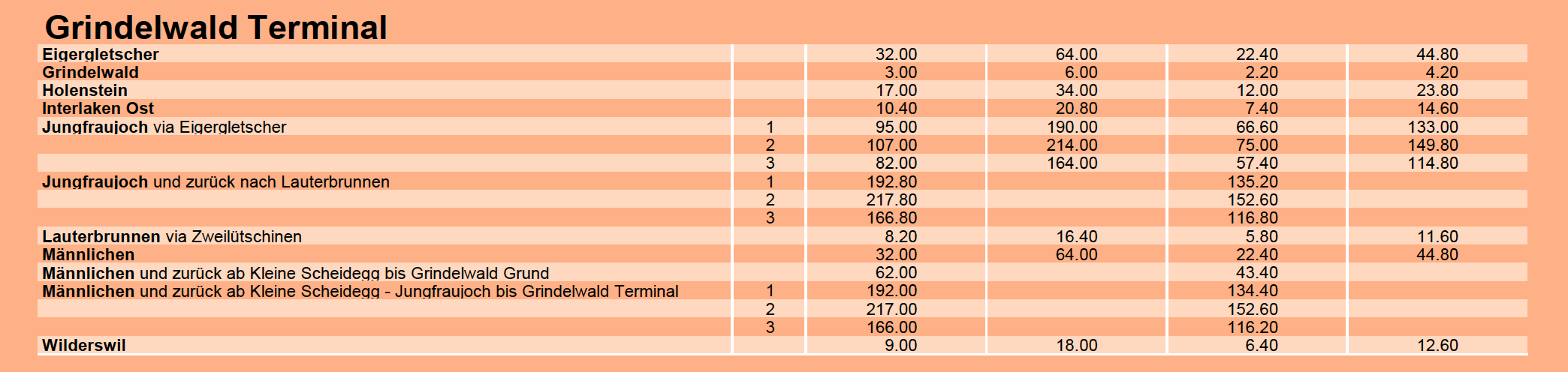
Below are some sample fares in Swiss francs, which at current exchange rates roughly equate 1 to 1 with the US dollar.  The trip to Eigengletscher from Grindelwald Terminal on the "3S" Eiger Express, a tri-cable gondola similar to the one proposed for Little Cottonwood, 64 Swiss francs/USD. 


The Eiger Express is about 6.5 km (4 miles) long and the ride takes about 15 minutes.  This is about half the length of the Little Cottonwood Gondola.  

You can get discounts.  We elected to buy a Swiss Half-Fare card for 120 Swiss francs, which gave us 50% off on all our our rail and cablecar travels in Switzerland.  Still, with that discount, the Eiger Express is 32 Swiss francs/USD round trip.  Alternatively, you can by a Jungfrau pass to cover much of the transport (190 for 3 days, 215 for 4, although the Jungfraujoch cog railway is additional).  

Switzerland is expensive and our days in the Jungfrau, while incredible, were surely the most expensive vacation days of our lives.  It's clearly an area for the well heeled, and I don't mean people who can hike a long ways.  

It makes me wonder about the future of the Wasatch.  If the Little Cottonwood Gondola is built, how much will it cost for individual users?  How accessible will the central Wasatch be for the broader community, not just those with financial means?