Showing posts with label Snowmaking. Show all posts

Saturday, December 27, 2025

The Birth of "Snow Augmentation" at Sun Valley

While researching the 1976/77 drought year, I came across the article below in the Salt Lake Tribune describing the benefits of "Snow Augmentation" at Sun Valley (click to enlarge).  


Published in late December 1976 when Utah resorts were not operating due to a lack of snow, it describes initial use of artificial snowmaking at Sun Valley.  Today, Sun Valley probably has one of the best snowmaking systems in the world.  At that time, during the great snow drought of 1976/77, it enabled three runs to be open for the holidays.  As described in the article,

"Ribbons of artificial snow from two to three feet deep have been shot by air compressor-activated snow guns up to two-thirds of the way up the mountain."  

It goes on describe the artificial snow as "cube like crystals" with "a bit more density than nature's snow."  I'm sure that sounds familiar to today's skiers.  The system sounded pretty cutting edge for the time, pulling 1400 gallons a minute and putting down two acre-feet of snow in eight hours.  

I suspect in 1976 there were no Utah ski resorts with snowmaking.  It would be interesting to look into the history of snowmaking investment and expansion at our resorts.  Online articles suggest Deer Valley had a snowmaking system when it opened in 1981.  Prior to the 2002 Olympics, Snowbasin expanded and installed what was probably at the time the state's most expansive and sophisticated snowmaking system.  My recollection is that Alta was not yet making snow when I moved here in 1995, but perhaps my memory is inaccurate.  AI tells a lot of good stories, but they can be authoritative BS so I'm reluctant to use it here.  

That said, as we have learned this season, most contemporary snowmaking systems today are still at the mercy of Mother Nature.   If wet-bulb temperatures are too high, snowmaking efforts are hopeless.  This has been a major issue in Utah so far this season (although guns will be roaring in the during and in the wake of this latest cold surge).  All-weather snowmaking systems are available, but are expensive to buy and operate and not used to cover large areas of terrain.  

Let's hope we see a colder, snowier pattern emerge for 2026.  

Wednesday, February 16, 2022

The Winter Olympics and Snowmaking

The holding of a Winter Olympics in a region that gets very little snow has cast a media spotlight on Olympic snowmaking and climate change.  Especially attention grabbing has been the Yanqing Alpine Venue where, until a small storm a couple of days ago, featured ribbons of artificial snow covering the courses. 

The lack of natural snow at that venue really makes the extensive use of artificial snowmaking stand out.  Media reports suggest that a million cubic meters of water was used for snowmaking for Beijing.  I wanted to check that number and dis some searching.  The Beijing 2022 Pre-Games Sustainability Report estimates that the total water demand for the Winter Olympics (November to March) in the Yanqing Zone Venues was estimated to be about 890,000 cubic meters and and for the Zhangijakou Zone Venues is 1.9 million cubic meters.  These numbers include all water consumption.  For the Zhangijakou Zone, the 1.9 million cubic meters includes 730,000 cubic meters for snowmaking and 1.17 cubic meters for domestic water consumption.  Assuming the snowmaking and domestic water consumption scale similarly for Yanqing, that gives a number that is around 1.07 million.  

How does that compare with other Olympics?  Media reports from Sochi 2014 suggest that 230 million gallons of water was used for snowmaking at the Rosa Khutor Alpine Venue.  That's 870,000 cubic meters of water.  Similarly, for the Pyeongchang 2018 Jeongseon Alpine Venue 200 million gallons was used (about 750,000 cubic meters).  Those numbers are just for the Alpine Venues.  If you add in snowmaking for cross country, biathalon, ski jumping, freestyle, etc., you're probably up around or above 1 million cubic meters.  

A lot of people have argued that the Olympics should be moved to a snowier location.  For instance, what if the Games come back to Utah in 2030 or 2034?  Utah is pretty snowy right?  

My experience during the 2002 Winter Olympics was that snowmaking was used extensively to build up a sufficient snowpack early in the winter to guarantee events will be held in February.  This happened even at Snowbasin, the highest and snowiest venue.  At a venue like Soldier Hollow, which is lower and definitely not snow sure, snowmaking was used extensively and even during non Olympic years is absolutely essential for operations.  Soldier Hollow had major problems with their snowmaking system a few years ago, forcing all sorts of disruptions.  I suspect that the water consumption at Soldier Hollow for snowmaking on a per kilometer of trail basis is not dramatically different than for the Cross Country and Biathalon venues for Beijing.  If Salt Lake City hosts the 2030 or 2034 Games, expect a lot of snow to be made.  

Alternatively, let's look at snowmaking at ski resorts.  Here's an example from the Kitzbuhel area in Austria based on a paper that was published in 2008.  This is a major resort area, which in 2008 consisted of 20 cities and villages with 6.5 million overnight stays per year by tourists, 54% of which occurred from December to March.  In this region, annual public water demand was 3.5 million cubic meters, of which 1.5 million was for overnight tourist stays.  It was estimated, however, that artificial snowmaking for the resorts required an additional 2.3 million cubic meters of water.  

The reality is that the modern Olympic Games require snowmaking.  As do many World Cup events and training facilities.  There are two reasons for this.  One is climate change.  Another is course preparation demands that require substantial amounts of snow and snow farming.  There are few places where superpipes and slopestyle courses can be built from natural snow alone.  

The 2026 Winter Olympics are will be in Milano-Cortina.  The modern Winter Olympics requires a large host city (Lake Placid could never, by itself, host the current version of the Winter Olympics).  Hence Milan.  It also requires outdoor venues, which in the case of Milano-Cortina will be scattered through the Italian Alps in Livigno, Bormio Stelvio, Val di Fiemme, Cortina d'Ampezo, and Anterselva.  Snow will be made.  A lot of it.  Those resorts make a ton of snow for regular operations. 

They could also throw a lot more weather challenges at the athletes, venue managers, and local organizing committee.  As a fan and meteorologist, I'm looking forward to it already!

Wednesday, October 28, 2020

A Late October Inversion

Although inversion "season" doesn't begin until November 1, the reality is that we're in a pretty good inversion right now in late October.

Here are a couple cherry-picked observed temperatures at 7 am this morning:

  • Salt Lake City Airport (4226 ft): 30˚F
  • Snowbird SNOTEL (9177 ft): 40˚F

This morning's sounding from the airport shows a surface temperature of 32˚F.  You have to go all the way up to 13,397 feet (about 600 mb) to find a colder temperature.  

Source: SPC

That's where the free-atmosphere freezing level is.  You can find pockets of sub 32˚F air at the surface across northern Utah where overnight cold pools developed or cold air from the weekend cold surge persists in valleys, basins, and canyons, but beyond that, there's a mild airmass now in place. 

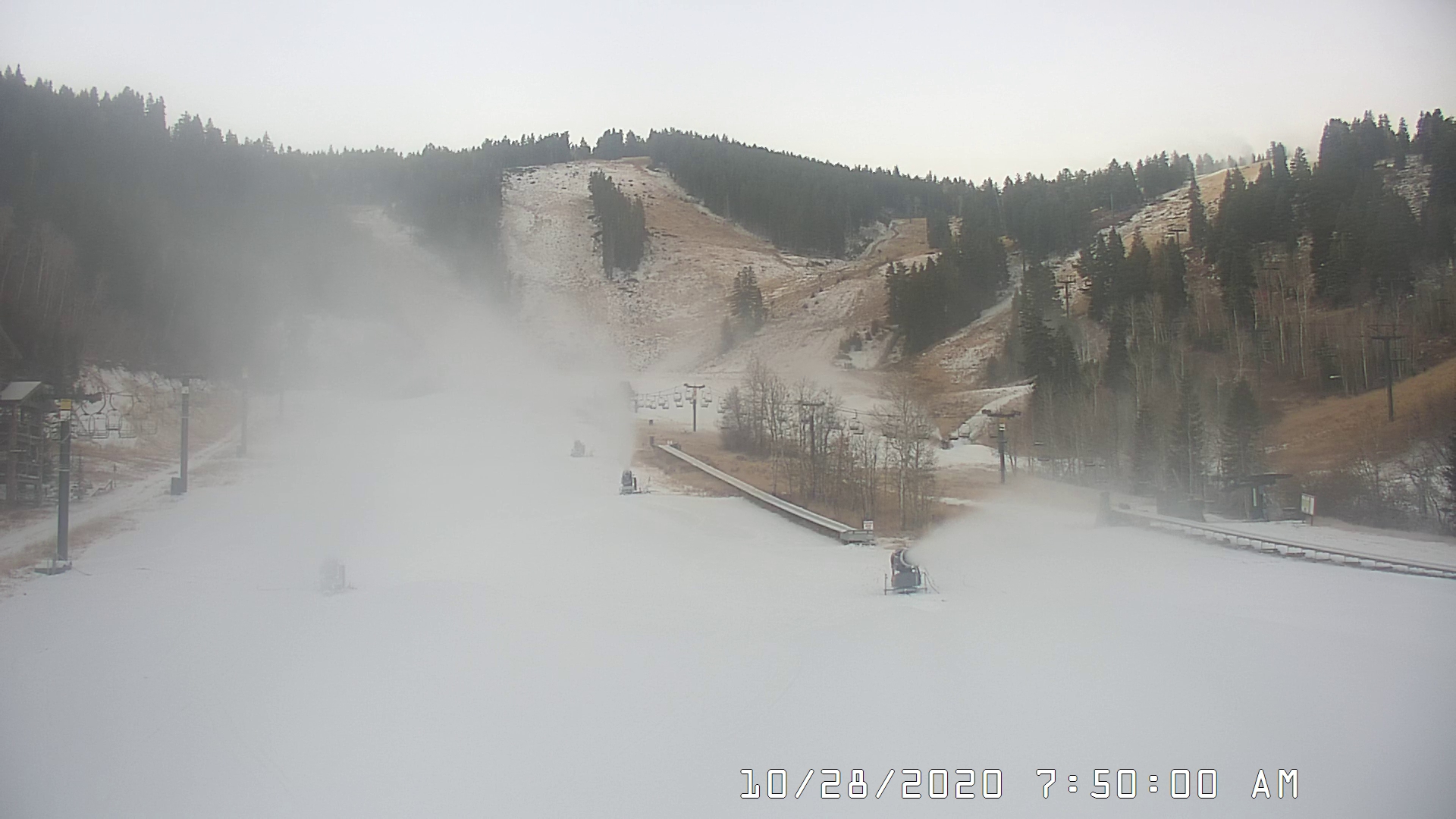
On Monday, Alta was making snow.  Look closely and you can see the guns running in Collins Gulch.  

Source: Alta.com

This morning?  It looks like they've either given up are are doing it in localized spots.  

Source: Alta.com

Nevertheless, a few resorts are doing what they can in the cold low spots.  The dryness of this airmass lends an assist since evaporation and sublimation of the droplets or ice particles created by the snow gun locally lowers the temperature.  

Source: Deer Valley

Meanwhile, haze was quite apparent in the Salt Lake Valley yesterday and PM2.5 concentrations pushed into the low-end of moderate in the Salt Lake Valley.  They have dropped back down into good overnight, but I suspect we'll see moderate air quality again this afternoon.  

Source: Utah Division of Air Quality

I'm not concerned about this becoming an air pollution event like we see in winter when there's snow on the ground and the sun angles are even lower.  Yesterday afternoon's sounding showed the boundary layer — the surface-based layer in which turbulence mixes pollution and other atmospheric variables — extended to about 6000 feet.  

Source: SPC

That's deeper than we see in our wintertime air pollution events.  

Model forecasts through Friday show similar conditions, so we will see some haze and perhaps higher PM2.5 levels, but probably not getting above high moderate levels.  

A weak frontal passage Friday night should stir things up a bit, but snow is unlikely and temperatures will not cool all that much.   Weather monotony continues.