Sunday, July 10, 2022

Alta Ski Report

 I rose early this morning and hiked up Sunset Peak from Brighton.  As I sat on the summit, stared westward over Alta, Snowbird, and the Alpine Ridge and wondered if there was any skiable snow remaining. 


Shortly thereafter I got a text from my son saying he skied the main chute, so apparently there is.  He described it as "awesome, but really scary."  I don't really know how to interpret that, but I guess it still goes.  

I haven't seen pictures, but imagine the white ribbon of death that remains won't survive long.  I haven't had the courage to look at the models, but I took at peak at the NWS forecast for the airport and the highs are:

Monday 96
Tuesday 100
Wednesday 101
Thursday 100
Friday 99
Saturday 99
Sunday 99

The forecast low for tonight is, however, 69˚F.  We'll see if that verifies, but it will be the first sub-70 reading of the month if it does.  

Tuesday, July 5, 2022

Possible Record Low Great Salt Lake

The Great Salt Lake is expected to set a new historical low elevation at the Saltair Boat Harbor this year and provisional data from the USGS suggests it is pretty close to that level right now.

Below is yesterday's MODIS image from NASA's Aqua satellite showing the large area of exposed playa the northern and southern arms of the lake, including the former Farmington Bay immediately adjacent to Antelope Island and the Salt Lake Valley.  

Observations from the USGS at the Saltair Boat Harbor show that the highest lake elevations since 2007 were achieved in 2013 when the lake was near 4199 feet.  Last year, we bottomed out at 4190.4 feet, which is the record low at this site.  The recovery this spring was limited.  


The latest provisional data since June 1 shows the general downward trend with measurements since July 2 near or below 4190.4 feet, the current record. 


Lake-elevation observations are tricky, so the USGS will need to weigh in on whether or not we are "officially" at the record low, but it appears we are close.  With a few months of decline likely to come, we will easily beat that record by the end of fall and may drop down to near 4189 feet.  

A lot of people ask me about the future of the lake.  In the short term, a best-case scenario would be a return to snowier winters that we have generally seen over the past two decades.  Some temporary recovery would be possible if that occurred. On the other hand, shrinkage will continue if we see the drought persist.  Efforts to increase natural flows to the lake will help slow the shrinkage, but in the long term, I suspect aridification due to climate change will make "saving" the Great Salt Lake as we know it very difficult without importing water.  

Sunday, July 3, 2022

Hairdryer Conditions

Heat, wind, low relative humidity.  Hairdryer conditions are dominating the weather story over northern Utah this holiday weekend.  

Meteograms for the Salt Lake City International Airport (KSLC) over the 24-hour period ending at just after noon today (Sunday, July 3rd) illustrate this well.  Yesterday afternoon, temperatures hovered near 100˚F (the official high was 101˚F) with dewpoints in the mid 20's and the relative humidity below 10%.  Winds gusted as high as 38 mph.  

Today is pretty much a repeat.  

For drying out the landscape, this is about as bad of a pattern as you can have.  

Sadly, the monsoon moisture isn't that far away.  The NAM forecast for this afternoon shows a sharp contrast in low-level relative humidity between western Utah and western Colorado (see lower left panel below), with considerable shower and thunderstorm activity over the latter.  


Both regions are in southwesterly flow.  The difference is origin.  In western Utah, our flow is moving around the upper-level low off the Pacific Northwest Coast and originates in the dry belt over the eastern Pacific.  In contrast, in western Colorado, the flow is moving around the upper-level ridge centered over the southern Plains and originates over the Gulf of Mexico.  The confluence of these two airstreams creates a sharp contrast in weather.  This is a common pattern during the monsoon and one of the reasons why eastern Arizona, New Mexico, and Colorado are more active than northern Utah.  

Your best option for this weekend is to stay in the shade or at high elevation, drink a lot of water, and don't play with fireworks.

Friday, July 1, 2022

June and July

I have very little intuition for what Utah experienced in June.  I was gone for nearly the entire month.  I didn't see a temperature above 80˚F for 3 weeks in Ireland and England and experienced a 12-day stretch in Ireland when I didn't see anything above 70˚F.  In a word.  WONDERFUL.  

The numbers for KSLC, however, show that June was warm compared to climatological norms with an average temperature of 74.7˚F, rating as the 8th warmest on record.

Source: NOAA Regional Climate Centers

A look at the time series above and the top-10 warmest June's on record below shows that the dice have been loaded for warm Junes at KSLC in the 21st century and especially since 2010.  

Source: NOAA Regional Climate Centers

For precipitation, 0.56" was recorded at KSLC, which is a shade below median for the month.  Anecdotally, it seems it's remarkably green around here for late June, so perhaps the timing or antecedent moisture have been good for the plant health.  Looking statewide, the story varies considerably depending on location with a few areas well below average, a few well above, and much of the state near or just below.  Such is the fickle and localized nature of precipitation during the warm season.  

Source: https://water.weather.gov/precip/

We now enter July, when hope is limited in northern Utah.  Every now and then we might get a surprise trough or sustained monsoonal flow, but it is not the hottest and driest month climatologically for nothing.  I'm not optimistic. Thoughts and prayers.  

Saturday, June 25, 2022

Irish and English Travels

We dropped back into Utah last night after three weeks in Ireland and southern England.  Today is the first day I've used a desktop computer in three weeks.  It was a wonderful break!  I even tried to avoid using e-mail and removed my e-mail apps from my phone and tablet before going, but as soon as we got to Amsterdam our flight to Dublin was cancelled and they said "for updated travel information, check your e-mail."  So the first thing I did in Europe was install Outlook.  Lol.  

Ireland was simply wonderful.  I had no idea what a lovely country it is. Although it lacks big mountains, the hills and coastlines are rugged and beautiful.  It was cool and showery too, which we absolutely loved.  I think the highest temperature we saw there was about 21˚C when we were in Belfast.  The rest of the time it was sweater and shell weather. I can't tell you how good it felt.  

We did a full circumnavigation of the island, doing lots of short hikes and enjoying Irish food and beer.  We then spent a few days in London and southern England before returning.  Here's a longer than needed tour.  

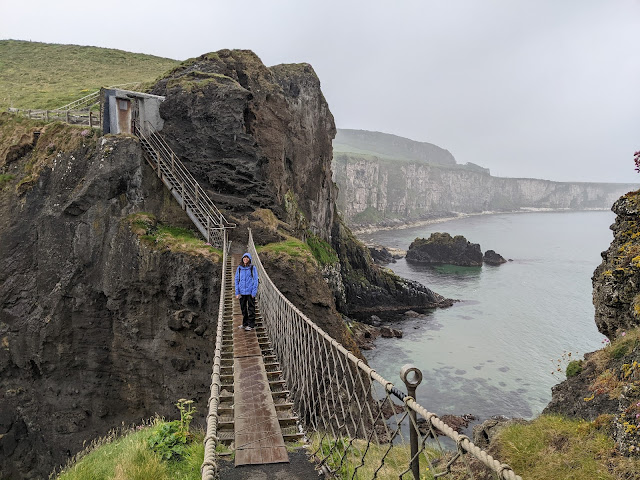
This is the Carrick-a-Rede rope bridge on the north coast.  It's a short hike and requires a fee.  I'm sure it is a massive tourist trap, but we get up early and it was raining and we had the place to ourselves.  Fantastic!

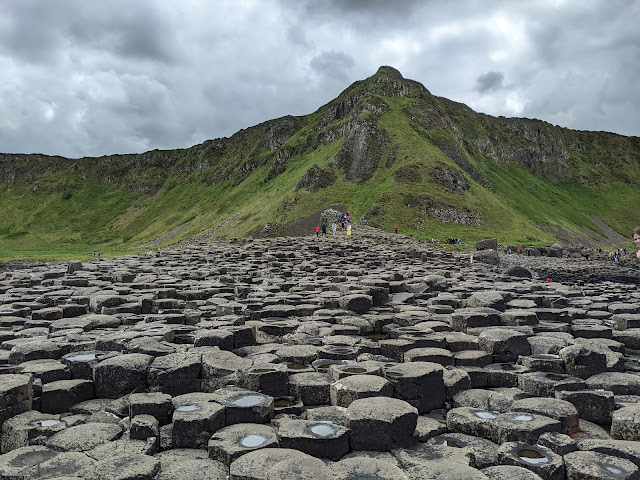
Giant's Causeway is a geological formation on the north coast, also very touristy, but pretty cool.  We parked in a far lot and did a nice circle hike through it.


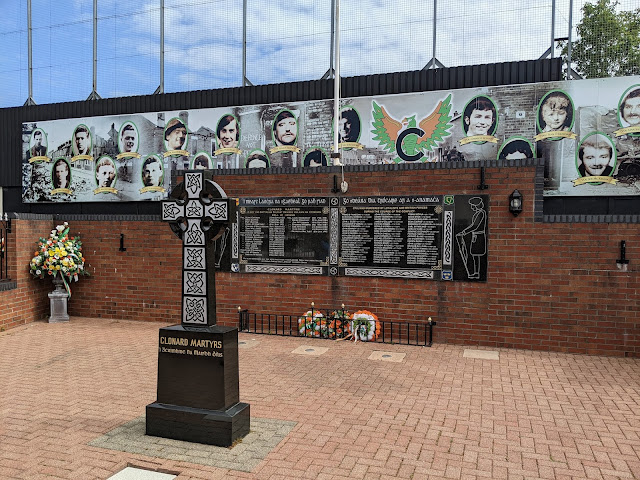
In Belfast and Derry we did some historical touring to try and understand Ireland's history and, more recently, The Troubles.  This is a Peace Wall mural in Belfast honoring those killed by the British and Loyalists during the Troubles.  Others honor Loyalists killed.  About 3,500 people died during The Troubles.  I still have more to learn.  

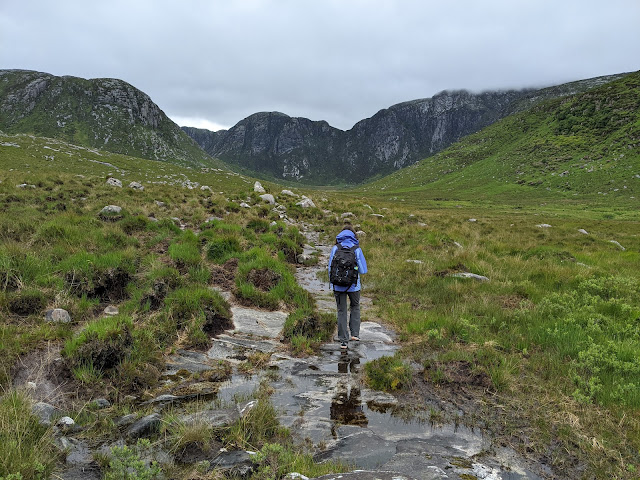
One of our favorite regions was County Donegal.  We saw few people here.  We did a short hike up the "Poisoned Glen."  The source of the name is unclear, but could be a mistranslation.  For the rock climbers, the mountains in the distance house Ireland's largest rock face, the Beamas Buttress.  It's a wet walk to get there.  

Dunlewey Church (abandoned) at the head of the Poisoned Glen.  Scenes like this are everywhere. 

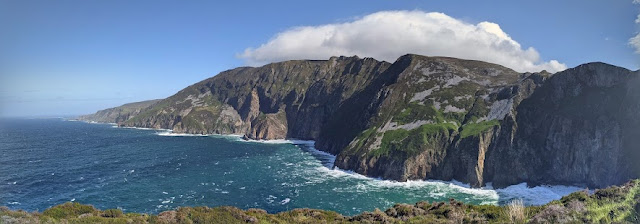
When we started our hike to Slieve League, it was pouring and the wind was blowing hard.  We were in full rain gear.  As we approached the overlook, the clouds parted and we got this incredible view.  These are the among the highest sea cliffs in Europe.  Can you see the orographic cloud?

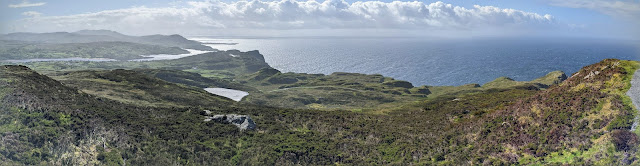
It is possible to hike out along the Slieve League Ridge, but my foot was still giving me trouble so we did a shorter hike up to One Man's Pass.  What scenery!

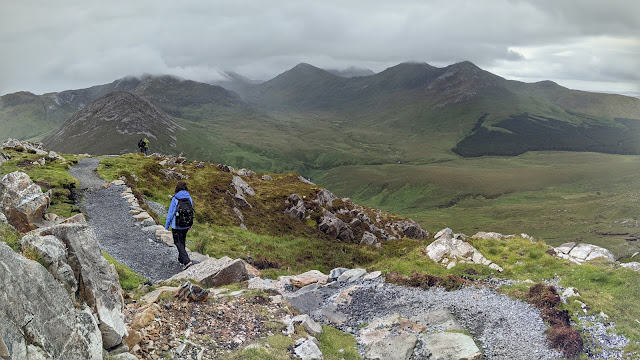
Near the summit of Silver Hill in Connemara National Park.

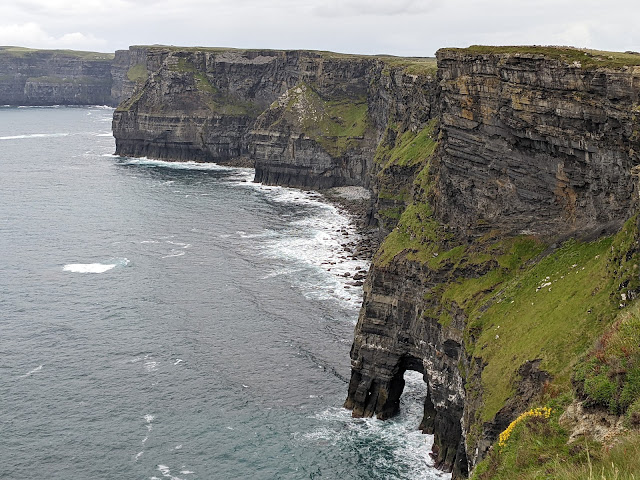
The Cliffs of Moher are one of Ireland's more popular natural wonders.  There is a crowded visitor center near there highest point, but we hiked in from Hag's head to the south, which given our early start was pretty quiet (it was busier when we returned).

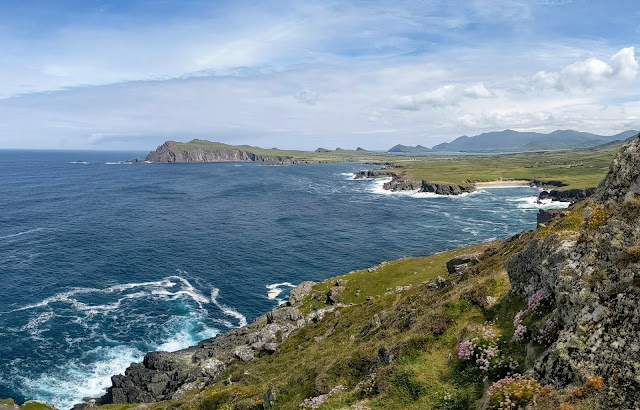
One of our favorite areas was the Dingle Peninsula.  This was taken near Clougher Head.

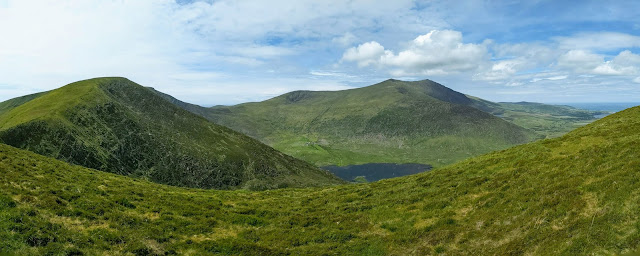
Also on the Dingle Peninsula is the Brandon Group Mountain Range.  We did a short hike from Connor Pass to enjoy the vistas.  Yeah, it was green.  I believe that Brandon Peak is right of center in this photo.

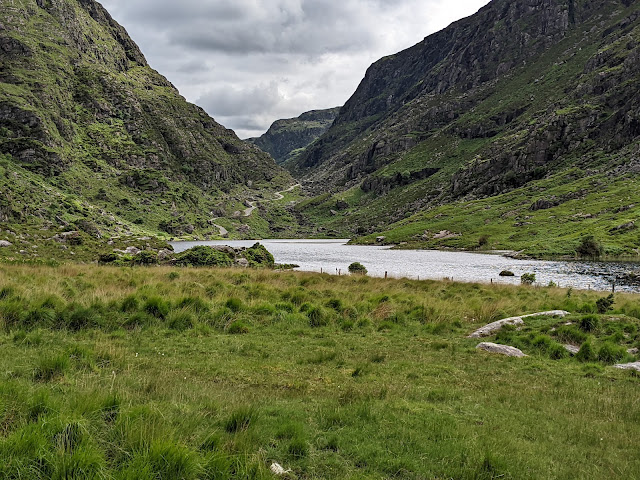
One day as we were driving along we saw a sign for the Gap of Dunloe.  I had seen it previously on a map and said we should check it out.  The thing about Ireland is you never know what the roads are going to be like.  Turns out, the road is one lane, has two way traffic, and is traveled by hikers, bikers, horses, horse-drawn carriages, etc.  It was, however, late in the day and we largely had the place to ourselves.  The hills here have an incredible ancient feel.

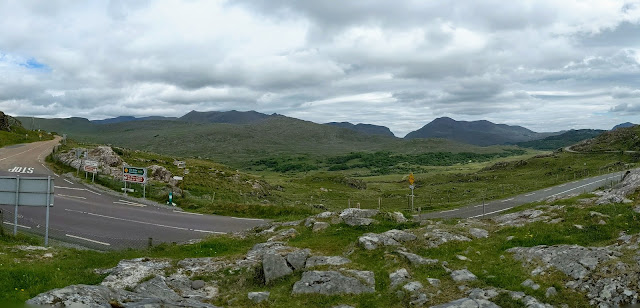
Above is the view of the Gap of Dunloe from Molls Gap.  The mountains to the left of the gap are the highest in Ireland at a bit over 1000 meters.  My foot was not ready for an ascent on this trip, but I would like to return and hike them.  

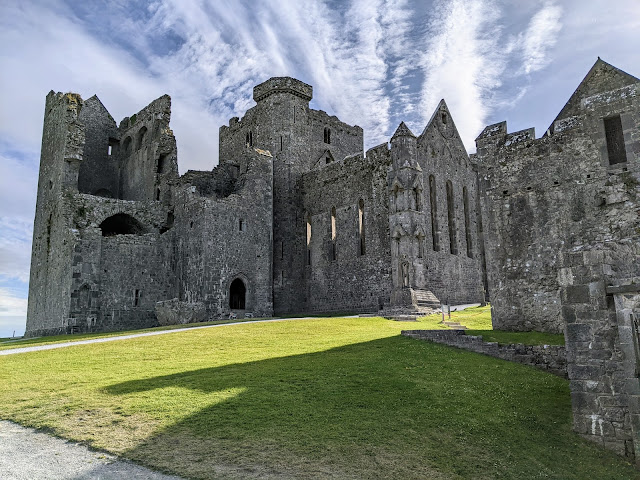
We made the obligatory stop at the Blarney Castle, which houses the Blarney Stone.  We enjoyed the grounds but skipped kissing the Blarney Stone as it was an hour-long line and I've never really been into that sort of thing.  The next day we went to the Rock of Cashel, pictured above, which was far more impressive than Blarney Castle.  

We flew across the Irish Sea to London for a few days.  Yes, we did this.  I am a closet Harry Potter film. We had a great time.

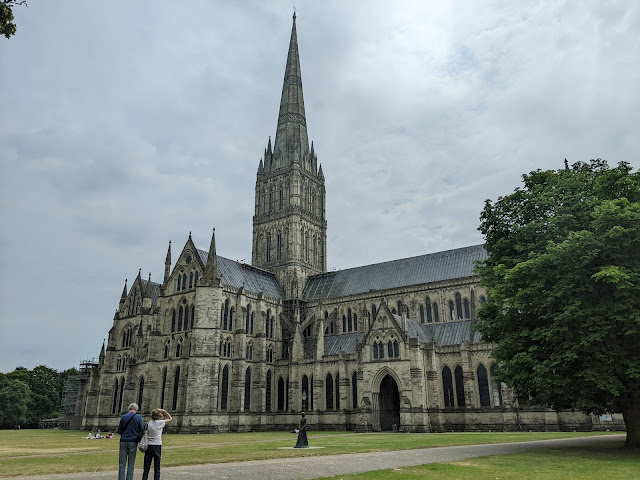
On our last touring day in England, we made an unplanned stop in Salisbury and decided to check out the Cathedral there.  Amazing.  Construction started in 1200.  The main spire is 404 feet high and was built in the early 1300s.  It is the tallest medieval structure in England.  

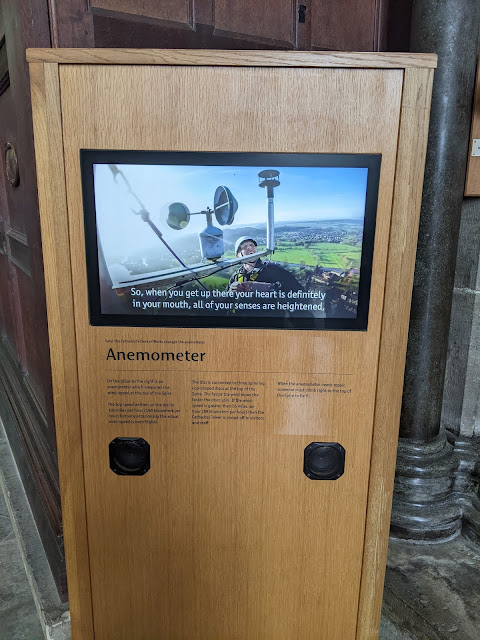
But, it gets better.  They have a weather station on the spire.  I understand there's a weather station on Mt. Everest, but this was incredibly cool.  An anemometer on an 800 year old, 400 foot high spire!  And it's no easy feat getting up there.  It's incredible to think about building such a structure back in the 1300s.

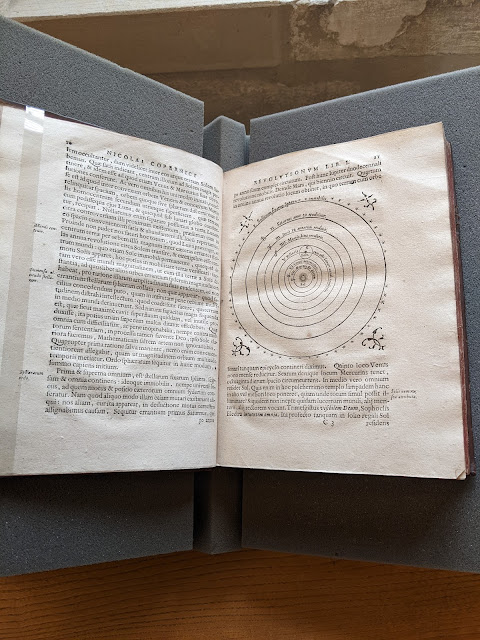
And it gets even better than that.  As we were exiting the cathedral, one of the cathedral workers asked if we would like to see the library.  I was going to say no, but somehow we decided to check it out.  In it, they had a Nocolas Copernicus' De revolution iorbium coelestium, 3rd edition, published in 1617, shortly after it would have been placed on the Catholic Church's Index of Prohibited books (see https://www.gla.ac.uk/myglasgow/library/files/special/exhibns/month/apr2008.html).  The first edition was published in 1542.

Thanks for entertaining my travel blogging.  I'll be attending the Mountain Meteorology Conference in Park City next week, so blogging may continue to be light for a while longer.  

Wednesday, June 1, 2022

Blog Break

It's been a long 2+ years since the start of the pandemic.  I'm taking some downtime for the next few weeks.  Blogging will be very light to non-existent.  Enjoy the first month plus of meteorological summer.